

No Girls Allowed
How the Democratic and Republican Parties Saved America From a Bunch of Nosy, Meddling Dames.
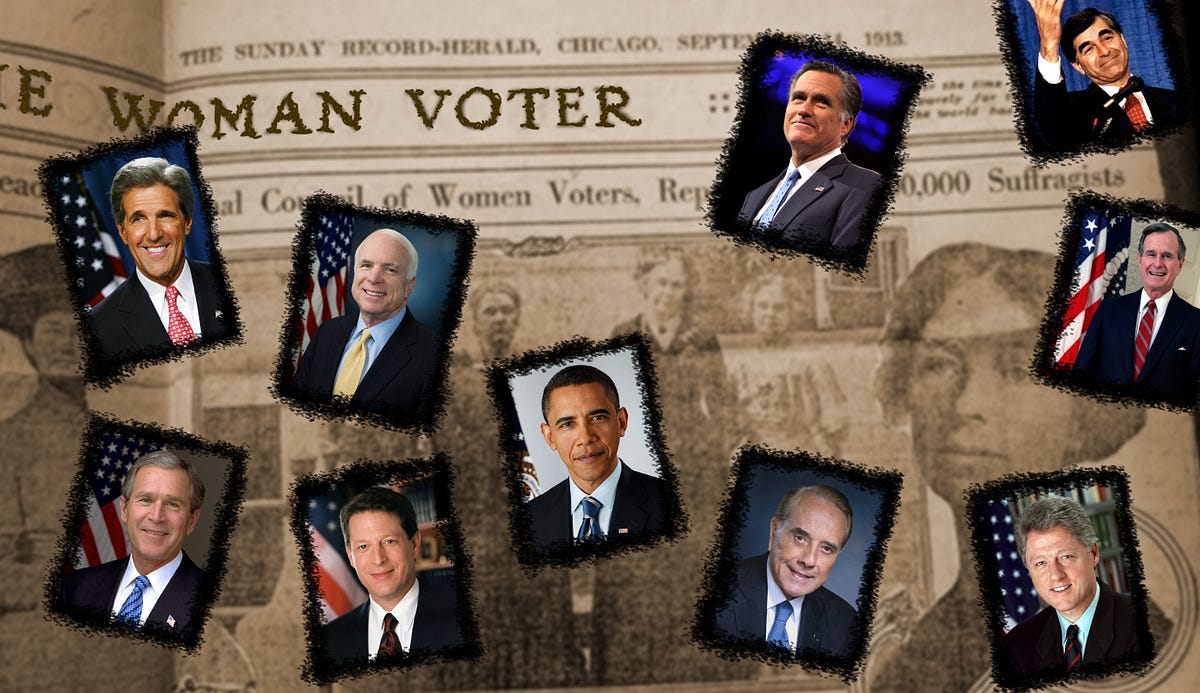
If you’re finding this title a little offensive, wait until you read the true story that inspired it. And if you’re wondering why our Presidential Debates are the opposite of everything you’d like them to be, well, this story will provide you with the exact, irrefutable answer… but you’re not going to like it.
It begins in July of 1848, the month women’s suffrage became an official movement in Seneca Falls, NY. Just imagine: slavery was still legal, and it would be another 22 years before men with dark skin could vote- a difficult battle in itself- yet enlightened women had already begun to take up the voting cause. When the 15th Amendment finally did pass, it prohibited governments from denying anyone the vote based on race or color, but not gender- so Susan B. Anthony and her gang petitioned Congress to extend those rights to women, only to be completely ignored by Washington. And the battle waged on…
Despite this seemingly-obvious injustice towards half the country’s population, the idea of universal voting rights was opposed by a lot of people for a variety of reasons. Big Business believed women would use their newly-given power to campaign against the abusive working conditions they (and children) were being subjected to in factories across the country, for example- and that meant smaller profits. Hence, the Textile Industry fought the suffrage movement tooth & nail, as did the Alcohol Industry (for fear that these meddling prohibitionists would only grow in power if they could vote.) If you think gay marriage, gun control and abortion are hot topics, try and appreciate how fervently people- both men and women- fought against this inalienable right:
“One would not be very far from the truth if one alleged that there are no good women, but only women who have lived under the influence of good men,” claimed the otherwise-brilliant immunologist Almroth E. Wright.
“Women are creatures of impulse and emotion, and do not decide questions on the ground of reason as men do,” argued the otherwise-liberal union leader William Cremer.
“We cannot reconcile feminism and the family. We hope to hear the sound of women’s feet, walking away from the factory and back to the home,”declared Kate Roosevelt, Teddy Roosevelt’s strong-minded cousin-in-law (ironic because Teddy himself fought fervently to give women the vote.)
In other words, letting women vote was bad for business, immoral, unintelligent, and against nature- these were the arguments and ideals suffragists had to battle for over 70 years. Seventy fucking years. So in 1920, when Congress finally decided it might make sense to let the other half of the country vote, the pressure was on womanhood to prove it actually deserved this new right. And with that onus, The League of Women Voters was born.
Superheroines to the Rescue
Arriving just one month after Prohibition came into effect, the League of Women Voters played an incredibly important role in America- especially in an era before mass-media. The League was there to encourage women to become active, thinking citizens through grassroots efforts all over the country- a difficult battle in itself, since many American women still believed voting was none of their business. But the League worked hard, and slowly its ideas spread throughout the land. It was fervently non-partisan, a factor that will come into play soon in our tale:
“League founders believed that maintaining a nonpartisan stance would protect the fledgling organization from becoming mired in the party politics of the day. However, League members were encouraged to be political themselves, by educating citizens about, and lobbying for, government and social reform legislation,” the League’s own history tells us.
We now jump to 1960, and the first televised presidential debate in American History- the one between Kennedy and Nixon that revolutionized the role of television in politics forever. Thanks to his five o’clock shadow, beads of sweat and dull-gray suit, the more experienced Nixon went from leading to trailing in the polls after that first debate, and never recovered- a lesson politicians have never forgotten. Perhaps out of fear of this powerful new medium, no debates were organized during the next few presidential elections, despite the growing public demand. Candidates weren’t overexposed as they are in today’s social-media world, and watching two potential world leaders answer tough questions in a rigorous intellectual setting was a rare opportunity for voters to see what their future leaders were really made of. Which is why, in 1976, the League of Women Voters finally managed to sponsor a televised debate between Gerald Ford and Jimmy Carter. You can watch it here, and note what a contrast it is in tone and depth from the empty circus we’ve come to accept from today’s substance-free version. Though an experiment for everyone involved, the debate was a huge success- prompting another one in 1980 between Jimmy Carter and Ronald Reagan. And that’s where our troubles begin.
The 1980 presidential race, like 2016, was a little crazy. Jimmy Carter had been a disappointment, but he was the incumbent; Ronald Reagan, full of Hollywood charm, was gaining strength, but his positions were radically conservative (for the time- now they’re pretty much in line with those of the Democratic Party, believe it or not) and scared a lot of centrist and progressive folks away. Enter John B. Anderson, a moderate Republican who had lost the party nomination to Reagan. Anderson was the good kind of Republican- conservative but honest, lacking that radical ideological zealousness that has since poisoned the Republican party- and his ideas, combined with his frank, straightforward responses, appealed to not just Republicans but a lot of frustrated Democrats as well. His rise in popularity scared Carter, to the point that our President refused to appear on a debate stage with Anderson. Today, this wouldn’t be a problem- not only would Anderson never be invited, but all the major newspapers and pundits would support that decision by simply not reporting it, or painting Anderson as either an egocentric spoiler or a crazy person living in the fringes of reality. But back then, journalists and the League of Women Voters had a different point of view- one that believed the voters were best served when you provided them with an intelligent political discourse between multiple competing voices. Lee Hanna, who directed the debate, put it this way:
“The important point is that this debate will supplement, perhaps even counteract, the quick impressions which they may be getting from 30-second commercial spots, from paid political announcements, from news filtered through television headline news programs, from wire-service reports upon which most people make their decision. This is the only opportunity people will have to see Jimmy Carter and Ronald Reagan stand up and face each other.”
But Carter wouldn’t budge, seeing Anderson as a threat. When the Democratsdemanded Anderson be barred from debating, the League of Women Voters refused to back down. Andersen was polling at 15%- the greatest third-party support in all of the 20th Century- and that was more than enough reason to allow his valuable point of view in the debate. Quoth Hanna:
“Most important is to prevent the candidates in advance from being allowed to make decisions about the agenda of the debates — how many there are to be, under what circumstances, what the subject matter should be, what the format is. Once they are involved, what we end up with is something that evolves out of compromise.”
And so the debate went on sans Carter- a lively debate which gave Anderson an instant boost in the polls, even though the election ultimately went to Ronnie Reagan. Was Anderson blasted in the press for “spoiling” the election for the Democrats? Not at all- rather, his inclusion was praised as a triumph for Democracy: “Certainly the public interest is served by the League of Women Voters’ decision to invite independent candidate John Anderson to participate,” wrote the Christian Science Monitor.
Then came the 1984 debate, where the now-savvier Democrats and Republicans started playing political games. In the past, figuring out which journalists would moderate the debates had been a simple and painless collaboration between both parties and the League. But this time around, each party automatically rejected any journalist the other side suggested-nearly 100 respectable journalists in total- with the goal of avoiding any hardball questions their candidates couldn’t answer. By the time the debate began, they still hadn’t decided on a fourth moderator- prompting Barbara Walters to begin the night by chastising the Democratic and Republican Parties in front of America: “On behalf of my fellow journalists, I very much regret- as does the League of Women Voters- that this situation has occurred.”
Due to negative public pressure, the two major parties backed off for the remaining debates- proving that, in 1984 at least, the American Public still had the power of scaring politicians. But being in the service of the people was not acceptable to the Democratic and Republican Parties, so a year later, they got together (how often does that happen?) to create the National Commission on Elections, which- surprise, surprise- concluded that the debates should be sponsored by the Democrats and Republicans themselves.On November 16, 1985, Frank J. Fahrenkopf Jr. and Paul G. Kirk Jr. (chairmen of the Republican & Democratic National Committees, respectively) issued this blunt, no-pussyfooting-around statement:
“It is our bipartisan view that a primary responsibility of each major political party is to educate and inform the American electorate of its fundamental philosophy and policies… through nationally televised joint appearances conducted between the presidential and vice presidential nominees of the two major political parties during general election campaigns… it is our conclusion that future joint appearances should be principally and jointly sponsored and conducted by the Republican and Democratic National Committees.”
Pay attention to the language: the League of Women Voters were specificallynonpartisan because that’s what serves the public interest best. This Committee was bipartisan instead. They didn’t recommend debates but joint appearances, and the candidates weren’t there to be challenged but simply toinform Americans of their policies. In other words, TV debates should be nothing more than a big infomercial starring one Democrat, one Republican, and no one else. That’s not my cynical interpretation- that’s exactly what this new committee publicly stated.
And that’s exactly what our debates are today- and have been ever since theCommission on Presidential Debates, which is what Fahrenkopf and Kirk renamed their bipartisan group, took the Debates over in 1988. The CPD is supposedly an independent organization, yet it happens to be fully run by high-level Democrats and Republicans. So when the Democratic and Republican Parties drafted a set of demands for the 1988 Presidential Debates, the CPD accepted those demands right away- which, of course, was why it had been created. Since Debates aren’t legally mandatory, the League had no clout with which to combat this hostile takeover- which, of course, had been the plan all along. The D’s and R’s gave the League a take-it-or-leave-it ultimatum, and the League of Women Voters, mindful of their duties to the American Public and refusing to tread down the slippery slope of political compromise, responded with this:
“It has become clear to us that the candidates’ organizations aim to add debates to their list of campaign-trail charades devoid of substance, spontaneity and honest answers to tough questions. The League has no intention of becoming an accessory to the hoodwinking of the American public.”
Ouch.
This should have been front-page news, the kind that kicks off movements and protests. But, while there was some criticism in the press, Americans didn’t really understand just how fundamental a shift this decision was in our political process. “Never in the history of this country have the people been so manipulated by image makers. If citizens don’t stand up soon and say, ‘We’re mad as hell and we’re not going to take it anymore,’ something of great value in the free democratic process will have been compromised,”warned league president Lois Saffian. Nostradamus couldn’t have predicted it any better.
CPD Grabs the Mic
With those pesky women out of the way, the CPD took hold of the reigns- and hasn’t let go yet. Why should they? FEC regulations prevented anyone other than a nonpartisan organization to run the debates, so the CPD simply redefined itself as nonpartisan. To this day, it remains a front for the Democrats and Republicans to do their dirty work behind. The D’s and R’s make up the rules, and the CPD carries them out. It raises the money to pay for the debates via corporate sponsorship (which isn’t too hard when you’re offering equal, intimate access to both parties with one simple check). Corporate sponsors don’t have to pick a side, and if the VIP parties they sponsor help shape future economic policy in their favor, all the better. Every four years, the two parties get together, write up their list of debate demandsin a secret Memo of Understanding, and the CPD accepts it without question- the exact opposite of how the League of Women Voters had run things. These memos have slowly been uncovered over the years, and they provide a fascinating insight into how much control the major parties have over what you see during a debate: everything from the position of the podium to the color of the backdrop to who is in the audience to what questions are asked (and what questions can’t be asked) to how long the responses can be to who asks the questions… and a lot more… are detailed in these memos. If you think you’re watching something unscripted and challenging when you sit down for a debate, check these memos out yourself and think again: 1992,1996, 2004, and 2012. If today’s Presidential Debate feels like a big show, that’s because it is- literally- a big show. You might as well go binge-watch Netflix.
With the CPD in charge, the resulting 1988 Bush-Dukakis debates were such a disappointment, CBS, NBC, ABC and CNN actually got together and proposed to take over the debates for 1992. They worked hard to conform their proposal with CPD demands but, in the end, Fahrenkopf and Kirk wouldn’t budge- hypocritically claiming that the networks were biased and, therefore, shouldn’t be allowed to sponsor anything- which is exactly the result the D’s and R’s wanted, of course. This “good cop / bad cop” relationship between the major parties and the CPD was (and is) an ideal one where any criticism attached to the way the debates were held could be deflected by Democrats and Republicans with the claim “we had nothing to do with this. The CPD’s the one in charge,” when, in fact, the opposite is true.
And how have the debates gone since then?
In 1992, a curveball by the name of Ross Perot shook things up again. Like John B. Anderson, Perot filled a public need created by the two lackluster options of George Bush and Bill Clinton. Perot had two important factors on his side- a straightforward, no-bullshit approach, and a ton of money to advertise himself with. Just as he was actually leading the polls in several states, Perot unexpectedly pulled out of the race, giving both Bush & Clinton’s numbers a boost. Surprisingly, Clinton received the bigger boost- a fact that didn’t go unnoticed by the Bush camp. So, when Perot decided he was back in the race a few months later, Bush demanded Perot be included in the forthcoming debates, hoping this would draw more votes away from the increasingly-popular sax-playing Democrat.
This was awkward, because the CPD (in line with both parties’ wishes) had made it clear they never wanted a third party involved in any presidential debate- yet here was the Bush camp breaking their unwritten rule in order to gain a political advantage. If the Clinton camp fought the request, however, they would look like Jimmy Carter did in 1980- afraid- and that would be worse, so they acquiesced. The result was the greatest debate series in years, and easily the greatest debate series we’ve had since. It resulted in the highest voter turnout since 1960’s JFK election, and Perot shot up from 9% in the polls to winning 19% of the popular vote- a stunning lesson in what the kind of exposure TV debates can bring a candidate. The reason for all of this was pretty simple- Perot’s inclusion in the debate kept things real, which is exactly what voters are starving for every election. With nothing to hide and nothing to lose, Ross Perot made the other two guys look like the tools that they were, and Americans loved it.
It’s also exactly what our major parties don’t want to see happen ever again, which brings us to 1996. Because he had received more than 5% of the popular vote, Perot’s Reform Party qualified for $29 million in Federal Campaign Funding. You’d think the man who garnered more votes in a presidential election than any third-party candidate in 80 years would have proven himself as “debate worthy” this time around, but not according to the CPD. This time, neither party wanted Perot anywhere near a debate, so of course, the CPD was ordered to ban him- but on what grounds? Their own, vague criteria was that they would allow a candidate into the debates if they had a “realistic chance of winning.” If any third-party candidate ever met this criteria, it was Ross Perot, as many important people reminded the public- including Senator Sam Nunn, Jesse Jackson, and CBS News Director Marty Plissner. But the CPD disagreed. Using such a brilliantly evil twist of logic, you almost have to admire it, the CPD took advantage of an FEC regulation that states that anyone who accepts federal funding can only spend $50,000 of their own, personal money in a campaign. Since Perot had spent millions of his own money when he ran in 1992, the CPD reasoned that in 1996, Perot wouldn’t have enough cash to run a successful campaign- precisely because the $29 million Perot had accepted automatically capped his personal spending limit at $50K. Read The Chicago Tribune’s version of this explanation again in case you don’t believe me, because it’s actually as insane as it sounds. Ross Perot’s success in 1992 was the very thing that negated his “realistic chance of success” in 1996- or so claimed the CPD.
Even dirtier was the fact that both parties pretended to have nothing to do with Perot’s exclusion, even while drafting a memo that stated the opposite. Clinton, in fact, went a step further, campaigning for Perot’s inclusion in public, which served to make Bob Dole look like a scared enemy of democracy. In David S. Broder’s book on the 1996 campaign, Clinton staffer George Stephanopoulos actually admits they never wanted Perot in the debate. When Chris Matthews asked him “why did you make us think you did?” Stephanopoulos brazenly responded “because we wanted Perot’s people to vote for us. How’s that for Candor?”
Perot sued to stop the debates, to no avail- everyone denied everything, he had no hard evidence of foul play, and the result was a very pointless series of non-debates between Clinton and Dole. Banished from the public eye, Perot fizzled out during the election, and America went back to sleep. We should note, however, that even in 1996, the press still very much recognized the importance of third parties. Major newspapers argued for Perot’s inclusion in the debates, as did most voters. This public pressure forced the CPD to come up with a better set of criteria than their wishy-washy “must have a realistic chance of winning” rule. So it ran some numbers and came up with the magical 15% threshold, as in, you needed to be polling at 15% voter support in order to qualify for a debate. When you recall that the CPD had invited Perot to debate while only polling at 9% in 1992, you have to wonder where this magical 15% materialized from.
With a 15% threshold, the only third-party candidate that would have qualified for a debate in the entire 20th Century would have been John B. Anderson; no other candidate ever polled that high. In fact, even if you knocked that number down to 5%, the only other person that would have qualified during the entire 20th Century was Perot in ’92. In other words, 15% is a bullshit threshold; it’s a nigh-impossible benchmark meant to keep third-party candidates out for good- which is exactly what has happened since. Every debate cycle, people protest the exclusion of third-party candidates, starting with Ralph Nader in 2000 and all the way up to 2016’s protests for Jill Stein and Gary Johnson. It’s a complete waste of time. It’s not that the protestors don’t have a case- they actually have a very strong case- it’s that none of this matters, because the CPD has a concrete 15% number in the bylaws (that they wrote) to hide behind, and no court is ever going to challenge that.
Welcome to the 21st Century
In 2000, both Ralph Nader and Pat Buchanan enjoyed strong support as third-party contenders, for the increasingly-common reason that both major party candidates left much to be desired. Nader was especially popular with young people, progressives, and even many celebrities, but none of that mattered, of course- he still wasn’t getting into a debate (literally- even when a student gave him his audience member ticket, Nader was physically thrown out.) Buchanan sued over the shadiness surrounding the CPD’s actions, and you should read the court’s own decision in the matter, because it’s shocking:
“The DNC stated that it ‘has no connection or relationship whatsoever with the … [CPD]’ and that ‘[t]he DNC does not now play, nor has it ever played, any role in determining the criteria for inclusion of candidates in any debates sponsored by the CPD….’ Likewise, the RNC disavowed any affiliation with the CPD or influence on the CPD’s debate criteria.”
Let’s pause there to remind ourselves that those secret memos of understanding previously mentioned clearly prove that the Democrats and Republicans are flat-out lying here. Now check the next part out (emphasis mine:)
“Plaintiffs’ argument makes sense, and the evidence they have marshaled in support of it is not insubstantial. An ordinary citizen might easily view the circumstances surrounding the creation of the CPD along with the evidence of major-party influence over the past three debates as giving some “reason to believe” that the CPD always has supported, and still does support, the two major parties to the detriment of all others. But, for better or worse, that is not the standard I must apply here…
…While reasonable people could certainly disagree about whether the CPD’s credibility determination was correct, under the extremely deferential standard of review that I must apply, the FEC is entitled to the benefit of the doubt even if the unfortunate by-product of the FEC’s decision is increased public cynicism about the integrity of our electoral system. Based on the factual record that was before it, the FEC did not abuse its discretion in finding that there was “no reason to believe” that the CPD currently “do[es] not endorse, support, or oppose political candidates or political parties.”
In case you missed that one: the court agreed that any reasonable person could see what a biased sham the CPD was, but because of the way the law had conveniently been worded, the judge had to find them innocent of any wrongdoing. The correct reaction to this statement by you should be: WTF?But here’s the part that we really need to think about: the “increased public cynicism” the judge mentioned- because that’s exactly where we are today. For all the love Nader received before November of 2000- and remember, this guy was a true American hero that had literally saved millions of lives through his legal battles against the auto industry and other irresponsible corporations- after the election, he became known as the egocentric pariah that handed Bush a victory. That utterly false claim conveniently perpetuated by the Democratic Party has created a chilling effect across America- one that is directly responsible for the low-quality candidates we’ve had to choose from since. We have become cynical and jaded about the entire process, to the point where half of us chastise anyone who doesn’t fall in line and embrace a major party, while the other half just doesn’t bother voting at all. With Nader and Buchanan swept aside, the 2000 debates were a joke between two corporate shills that no one much cared for. Some of the major TV networksdidn’t even bother carrying it, and Bush and Gore agreed on so many points, GW actually joked that the debate seemed “like we’re having a great love fest tonight.” It’s no wonder the debates had the lowest ratings in years.
The debates since have continued the trend: more secret deal memos sponsored by huge corporations like Philip Morris with more and more restrictive formats ensuring nothing of substance ever gets said. If the debates are the gauge most Americans use to vote with, and those debates are pre-planned, lifeless, unchallenging collections of sound bites between two uninspiring politicians no one likes, well… then there really is no hope for a better tomorrow, at least not one coming from the White House. Other than a full-blown national riot, I’m not sure what recourse Americans have to change things, either. The way we’re supposed to enact change is through the law- but brave Congresspeople has tried many times and gotten nowhere. Here’s a list:
• National Debates Act — proposed in 1989, 90, 91, 92, and 93; failed every time (even after it had been watered down to please opponents.)
• Democracy in Presidential Debates Act — proposed in 1991, but never made it past the House Committee on House Administration.
• Presidential Debate Commission — proposed as a replacement to the CPD in 1996; never made it past the House Committee on Oversight.
• Legislation that prohibited Candidates from barring any candidate who were on at 40 state ballots- proposed in 1997 and shot down in the House Committee on Oversight.
• A similar bill proposed by Rep. James Traficant in 1998, once again shot down in the House Committee on Oversight.
• A Jesse Jackson-proposed bill in 2000 that would lower the 15% third-party threshold for debates to 5%, killed by the House Committee on House Administration.
And that’s just the 20th Century. A couple of years after G.W. Bush became our president, journalist George Farah published No Debate- an incredibly well-researched expose which completely influenced and informed the piece you are now reading. Though my research links are mostly my own, Farah’s book lays down the argument so convincingly, and with such thorough evidence, it’s impossible to avoid following it here. So why am I basically regurgitating his work?
Because over a decade later, things have only gotten worse. No Debate should have hit this country like a nuclear bomb, enraging us all to march, protest, and demand the resignation of the CPD. Instead, the media ignored it, and no one read the book. You can get a used copy for $4 if you’re interested. The2004 and 2012 secret memos confirm the same trend of bland, pointless, fully scripted debates, and no doubt 2016’s is no different. There’s no need to keep asking yourself why these debates are such a painful waste of time, because the answer is here in Farah’s book, which provides a much deeper investigation, which much more evidence, into this scam of the century.
And it’s not just the debates- our entire political process had suffered as a result of the CPD. Just take the case of Bernie Sanders. With a similar platform, Ralph Nader managed just 2.74% of the popular vote in 2000, and even less in the years after. But Sanders brought us the same message under the umbrella of the Democratic Party, and he received more individual contributions than anyone in the history of America. That’s the story of the year- as well as the subsequent torpedoing of his campaign by the DNC. Rather than strike out on his own as a third-party candidate, the fiery Sanders quietly stepped aside, leaving millions of supporters frustrated and confused. But it’s not really that confusing. After a lifetime in politics, Sanders knows full well that going third-party would leave him ostracized by his Washington peers and get himself recast by the media as another egotistical pariah risking a Democratic split. In other words, it would kill his career and make his political clout disappear.
Which is a tragedy, because Sanders could have easily hit the 15% mark in the polls and earned his right to appear on stage in a debate series that has been seriously lacking in substance (and class) by both sides. While Earth moves past the point of no return, climate-wise, neither Trump nor Clinton have deemed our environment something worth bringing up in the debates- and neither have the moderators, most likely because they were ordered not to. If America was ever in need of a viable third option, it would be 2016- and yet, thanks to the CPD’s bipartisan control, the one guy who could have saved the day chose to stay away.
When the League of Women Voters went with integrity and ethics over political posturing by pulling out of the debate business in 1988, they were a well-respected group, trusted by most Americans, and playing an integral part in keeping our system honest. At the time, they were condescendingly considered old fashioned by the savvy, modern political machine that shoved them out- a machine that most likely considered them no different than the “annoying busybodies” that had managed to ban alcohol so many decades ago. But the League’s quaint little idealistic values are making a comeback in America’s modern conscience. Check out their current public policies and you’ll find a platform as progressive as anything Bernie Sanders has been advocating for; like the original suffragists, it turns out the League is still ahead of its time.
Soon, a woman will be commanding from the White House for the first time in history, but her corporate agenda and compromised positions will sadly rob the feminist movement of the epic victory such a milestone should be. If we really want our next generation of women to feel politically empowered, we need to forget the ethically-bankrupt world of the Beltway, unplug from a two-party system that couldn’t care less about the public interest, and go back to the time before we took a wrong turn: with the League of Women Voters, quite possibly the truest group of American Superheroes we’ve ever had.

This post have 0 commentaires
EmoticonEmoticon